Grounds · 2026-05-28 · Updated 2026-07-13 · By Spud
Lord's, the Home of Cricket: a visitor's guide
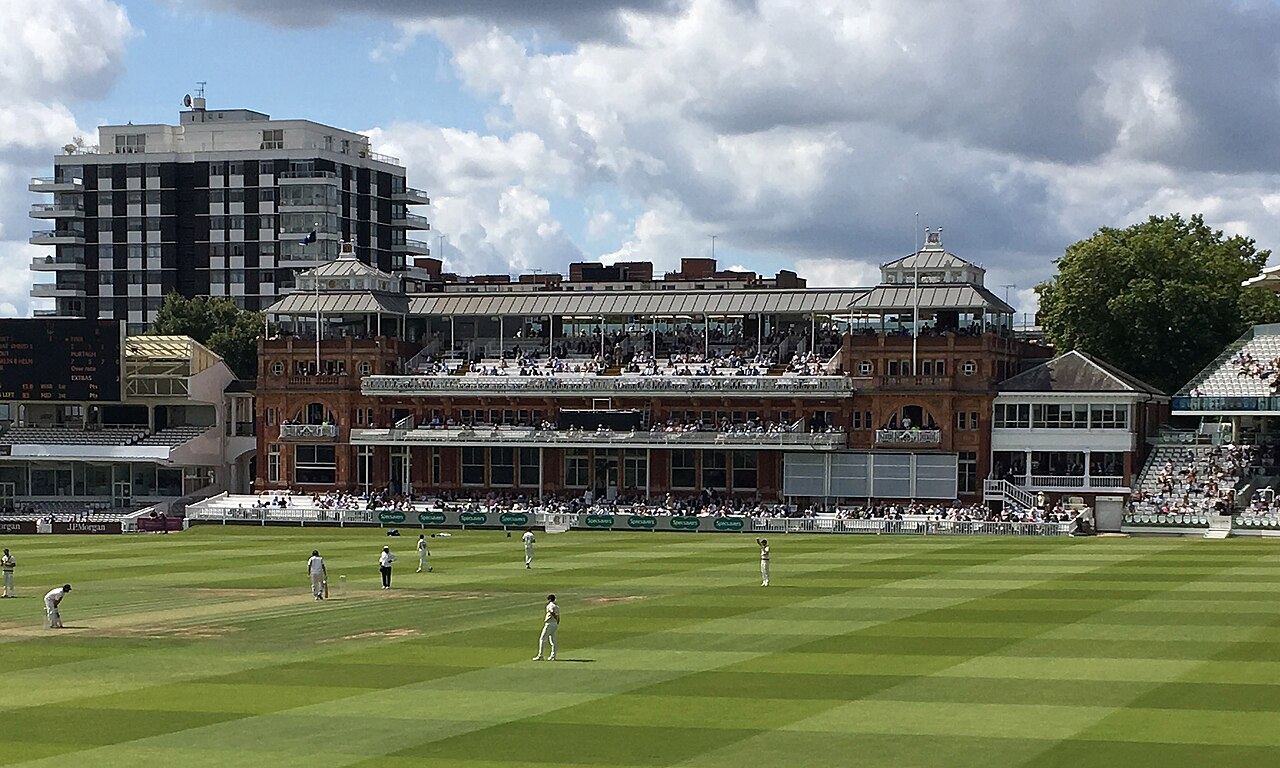
Ask any cricketer where they would most like to score a hundred or take five wickets, and a great many will give the same answer: Lord's. The ground in St John's Wood, north-west London, has been the spiritual centre of the game for more than two centuries, and a day spent there is a day spent inside cricket's history.
Where the name comes from
Lord's is named not after any aristocrat but after Thomas Lord, an entrepreneur and bowler who opened his first ground in 1787. The current site — the third that Lord laid out — has staged cricket since 1814. It is the home of Marylebone Cricket Club, the MCC, which for most of the game's history was also its lawmaker. Today the ground is best known as the headquarters of Middlesex and as a Test venue for England, but its influence reaches every pitch in the world: the Laws of Cricket are still maintained by the MCC.
The famous slope
First-time visitors are often surprised to learn that the playing surface is not flat. Lord's has a pronounced slope that falls about two and a half metres from one side of the square to the other. Bowlers learn to use it: deliveries angled down the slope tend to swing and seam towards the slope, while those running up it behave differently. A bowler who can read the slope has a genuine advantage, and commentators will often talk about bowling "from the Pavilion End" or "the Nursery End" precisely because the two ends play so differently.
The Pavilion and the Long Room
The red-brick Pavilion, opened in 1890, is one of the most recognisable buildings in sport. Players walk out to bat through the Long Room, a wood-panelled hall lined with portraits and watched by members in their distinctive egg-and-bacon ties. For a batter, the walk through the Long Room and down the steps is one of the most nerve-jangling journeys in the game — applauded by members close enough to touch, then out into the light and the roar of a full house.
Opposite the Pavilion stands the futuristic Media Centre, a smooth aluminium pod raised on stilts that opened in 1999 and won architecture prizes. The contrast between the Victorian Pavilion and the spaceship-like press box captures Lord's nicely: a ground that guards its traditions while still moving with the times.
Great days at Lord's
Lord's has a knack for the historic occasion. It hosted the first men's Test match in England in 1884 and has staged finals of every major one-day tournament, including some of the most dramatic World Cup finals ever played. The honours boards in the home and away dressing rooms record the name of every player to score a Test century or take five wickets in an innings at the ground — a permanent reward that players treasure far beyond any trophy. To "get on the honours board" is a career ambition in itself.
The ground has also been at the centre of the women's game, hosting World Cup finals and full houses for England's women, and it remains a regular host for finals day atmosphere whenever a big match comes to town.
Visiting on a match day
- Getting there: St John's Wood on the Jubilee line is the closest Underground station, a few minutes' walk away. Match days are busy, so allow extra time.
- Arrive early: part of the pleasure of Lord's is the build-up — the warm-ups on the outfield, the queues at the Grace Gate, the smell of cut grass.
- Take the tour: on non-match days the MCC runs guided tours that take in the Long Room, the dressing rooms, the honours boards and the museum, where the tiny urn of the Ashes is kept.
- Dress code: some areas, including parts of the Pavilion, have a dress code, so it is worth checking before you travel.
A ground built for study
Part of what makes Lord's special to regular visitors is how much there is to notice beyond the cricket. Tucked behind the main ground is the Nursery Ground, a practice area where you can often watch players net before play, close enough to hear the thud of ball on bat. The MCC Museum, the oldest sports museum in the world, holds the original Ashes urn along with bats, blazers and curiosities from every era of the game. The Real Tennis court next door is a reminder that the club's traditions stretch well beyond cricket.
Seasoned spectators treat a day at Lord's as a slow pleasure. They arrive early to watch the warm-ups, walk the perimeter to take in the ground from every angle, and pick a seat that lets them read the slope. They watch how bowlers change ends to use it, how captains move fielders a few yards to plug a gap, and how the light shifts across the afternoon. Cricket rewards that kind of attention more than almost any sport, and there is no better classroom for it than the ground where the game wrote its rules.
Lord's in the modern game
For all its history, Lord's is not a museum. It hosts Test matches, one-day internationals and T20s, the annual England fixtures that sell out months in advance, and it has staged World Cup finals — including the famous 2019 decider settled by the barest of margins. Its blend of Victorian pavilion and space-age Media Centre keeps it visually unlike anywhere else, and its role as guardian of the Laws keeps it at the centre of the sport's governance as well as its imagination.
Why it still matters
Plenty of grounds are bigger. The Melbourne Cricket Ground holds three times as many people, and modern stadiums in India can match it for noise. What Lord's offers is something else: a sense of continuity with everyone who has ever played the game. The slope that troubles a bowler today troubled bowlers a hundred years ago. The honours boards carry names from every cricketing era. Walking out through the Long Room, a debutant joins a line that stretches back to the nineteenth century.
That is why, for all the money and spectacle that has flowed into modern cricket, Lord's keeps its title as the home of cricket. It is not the loudest ground, nor the largest, but it is the one that feels most like the place the game came from — and, for the players lucky enough to get their name on a board there, the place they will always remember most fondly.
Spotting it in crickedle
In the Ground Spotter mode, Lord's is one of the most recognisable venues in the pool — the Media Centre and the Pavilion are giveaways once you know them. Learning the look of the world's great grounds is exactly the skill the mode rewards, and few are as distinctive as the home of cricket. A photo and a trickle of hints are all you get, so knowing that red-brick frontage on sight is a genuine edge.
Fancy a challenge? crickedle is a free daily cricket guessing game with six modes — a new puzzle every day.
Play today's puzzle →